The Critic Missing the Critique (Again)

Over this past weekend Neil Shenvi, self-proclaimed “apologist” and frequent contributor to The Gospel Coalition and the Council of Biblical Manhood and Womenhood republished his review of Kristin Kobes DuMez’s Jesus and John Wayne to X. This immediately drew criticism and some much justified push back on multiple points. I want to walk through some of these issues because Shenvi is a good representation of a kind of online “leader” that certain Evangelical platforms have lent the power of their platform to.
It’s Six Years Later
It must be said at the outset that the review itself was written in 2021. This raises multiple issues with why Shenvi felt it was still relevant now. Firstly, there is the reality that the few things Shenvi did note were commendable about DuMez’s critique at the time, namely an abusive culture and a culture prone to militarism, that have only gotten appreciably worse. Shenvi himself was interviewed for a multi-part series on White Christian Nationalism and the rise of Nazism in the Evangelical/Reformed church. Therefore, it is quizzical that in putting out a critique of DuMez where he acknowledged the potential for error, he would not now rewrite/acknowledge that White Christian Nationalists have run off a preverbal cliff in those areas.
The second issue is even more revealing given a six-year time gap. Shenvi’s main contention in his review is that DuMez doesn’t use scripture or outline her personal beliefs theologically in the book, “Du Mez offers no exegesis of key biblical passages about gender, power, or authority. Indeed, the book offers little if any theological reflection at all on these issues.” Multiple people in responding to Shenvi stated that a history book wouldn’t contain those claims, nor would someone working in the social sciences ever include those issues if they wanted to be taken seriously by the academy. There is practically no way Shenvi hasn’t heard those explanations in the past five years. A quick reminder that Shenvi does not have a degree in either history or theology, his PHD is in Theoretical Chemistry. Neil could have gone back to school to get a history degree or even a Masters in Theology (or quite frankly both) in the past six years (I did). Yet Shenvi’s reposting as if his critique still holds merit even after being told that it doesn’t fit the genre or the discipline is quite frankly, stupid. Let me be clear, Shenvi can complain that this is the norm, or that he believes the Social Sciences should include a theological component (as it appears he believes absolutely everything is reflective of a theological ideology) but what he cannot do is fault a book for not containing something he deems important as if he’s the only audience.
Sadly, Shenvi is not alone in this kind of obtuseness. There are many who at best have a Masters in Divinity, but regularly only have a BA and only sometimes in something “Biblical” from a Bible college. This isn’t to say that people cannot have opinions outside of their field of education, but it is a serious problem when they at least by their rhetoric seem to claim an authority they, quite simply, do not have. A good example of this recently has been Josh Howerton. Howerton has waded into issues of politics, theology, and history where his lack of education is simply painfully obvious. This ignorance is repeated throughout the conservative evangelical landscape, from women who seemingly never attended any higher education erroneously invoking both scripture and history (TPUSA), to podcasters and a reporter with communications degrees repeating segregationist talking points and claiming they speak with scriptural authority, to men who have never actually studied history making millions off of lies, there is an entire culture within Evangelicalism that elevates the at best ignorant to the worst just stupidly dumb because they perpetuate a political agenda.
What is exceedingly problematic in this trend is the inability to engage in, or even fully show comprehension of arguments and criticisms outside of their presupposed ideologies. When Evangelicals can only approach anything as either being ideologically supportive (true) or ideologically antagonistic (false) what gets missed is the very nature of the critique. What is worse is when there is no evaluation of either criticism, critique, or even opinion unless it is coming from someone ideologically aligned. I’ve seen reporters asked about what they think about transgender people, I’ve been asked about whether I view the Bible as “inerrant” or whether I “value human life” and these litmus tests had nothing to do with the subject at hand. This reveals a stunting and to be quite frank indoctrination that simply cannot take in information and evaluate it.
Shenvi’s “review” of Jesus and John Wayne is in fact a great example of both not understanding the argument and failing to take the critique seriously.
So Close and Yet so Far
Other than Shenvi’s main complaint that, as said previously, is invalid to the genre and discipline he is criticizing he also misses the argument DuMez is making on both the examples he gives. In his first example Shenvi writes, “One of the main targets of Jesus and John Wayne is a “patriarchal” vision of masculinity. Du Mez’s thesis is that this understanding of gender is a corruption of the faith.” At this point I want to make something clear, DuMez defines in her book precisely what she means by “patriarchy”, so you automatically have here a misunderstanding of how a historian writes. DuMez argues that a particular expression of patriarchy rose to become the dominant and most definitional aspect of Evangelicalism. Now if anyone wants to contend with DuMez defition of “patriarchy” or claim that she is arguing that “patriarchy” is not really represented in the evidence she gives, that would be one argument, but that’s not what Shenvi does. He states, “Du Mez is not merely criticizing particular expressions of gender roles but the very existence of gender roles, either in the church or in the family.” Having read the book this is precisely what DuMetz is NOT doing.
What is telling is that it is Shenvi who is taking a “leap” of imagination in this argument not DuMez. He does not argue that Rushdoony and Dobson were not essentially promoting the same patriarchy just in differing degrees. He doesn’t refute whether the Danvers statement was to enshrine an expression of patriarchy as Biblical, or that CBMW and SBC seminaries have existed to primarily create a network of essentially patriarchal churches (evidence of this seen recently in the SBC’s vote to bar women from even pastoral “service”), it is he that makes the jump from those factual observations to an assertion that DuMez is arguing against ANY gendered distinction. Here is where the irony may lie, if Shenvi is assuming that the ONLY appropriate gender expression contains a hierarchical demand that men have authority over women, then he is making the very point of DuMez’s argument, that patriarchy has become definitional to the Evangelical imagination of society, politics and theology.
Shenvi’s second set of examples again show this unwillingness to see an argument as factual but instead presume someone is intending theological implications that the factual statements are not making. Shenvi raises DuMez’s characterization of the “Conservative Resurgence” in the SBC and the “cover” that it was an issue over inerrancy. DuMez claims, “the battle over inerrancy was in part a proxy fight over gender” (p. 108). Again, it is difficult to look at the direction of the SBC and of CBMW and not only wonder if “inerrancy” was not just mainly about gender “roles” but whether it was the ONLY concern of those who promoted it.
But there is another issue where Shenvi confuses factual statements with theological/ideological ones. Allow me to quote first what DuMez says then Shenvi’s response. The passage Shenvi quotes is,
“Within this expanding [evangelical] network, differences…could be smoothed over in the interest of promoting ‘watershed issues’ like complementarianism, the prohibition of homosexuality, the existence of hell, and substitutionary atonement. Most foundationally, they were united in a mutual commitment to patriarchal power… Over time, a common commitment to patriarchal power began to define the boundaries of the evangelical movement itself, as those who ran afoul of these orthodoxies quickly discovered. Evangelicals who offered competing visions of sexuality, gender, or the existence of hell found themselves excluded from conferences and associations, and their writings banned from popular evangelical bookstores and distribution channels. (p. 204)”
Again, this is a factual statement. Partnerships and “coalitions” that claimed to be ostensibly “for the gospel” really had only a few non-negotiables and patriarchy was one of the most necessary. Not only that, but there has been a noted intolerance on any deviance from agreed upon theological stances and one could argue those “fundamentals” have only sharpened through the years. Even mild departures like calling homosexuals to celibacy, or encouraging single women to pursue their education as a worthy calling and use of their singleness have devolved into extreme rancor.
What is telling is when Shenvi asks what really is a good question,
“If “patriarchal authority” is not only broad enough to include all complementarian views but is also the motive force behind evangelical commitment to a traditional view of inerrancy, gender, sexuality, the existence of hell and even substitutionary atonement, what happens if we commit ourselves to deconstructing “the patriarchy”?”
Of course, what Shenvi intends to insinuate is that the questioning of “patriarchy” will cause a “slippery slope” to the rejection of all Christian orthodoxy (which has not happened in most egalitarian churches BTW). But this again brings up a key question that DuMez’s work raises, if patriarchy (which Jesus himself never explicitly taught) has become so integral to American Evangelicalism that to question it is to question the entire doctrinal emphasis of the church, is the church now about nothing more than patriarchy? To put it another way, if we cannot tell the “good news” without patriarchy, has our gospel essentially become patriarchy and gender roles?
It Gets Worse
One can wonder again why Shenvi though his review dated six years ago was still relevant or dismiss it because it was written so long ago. What cannot be ignored is what he said in his own defense on X,
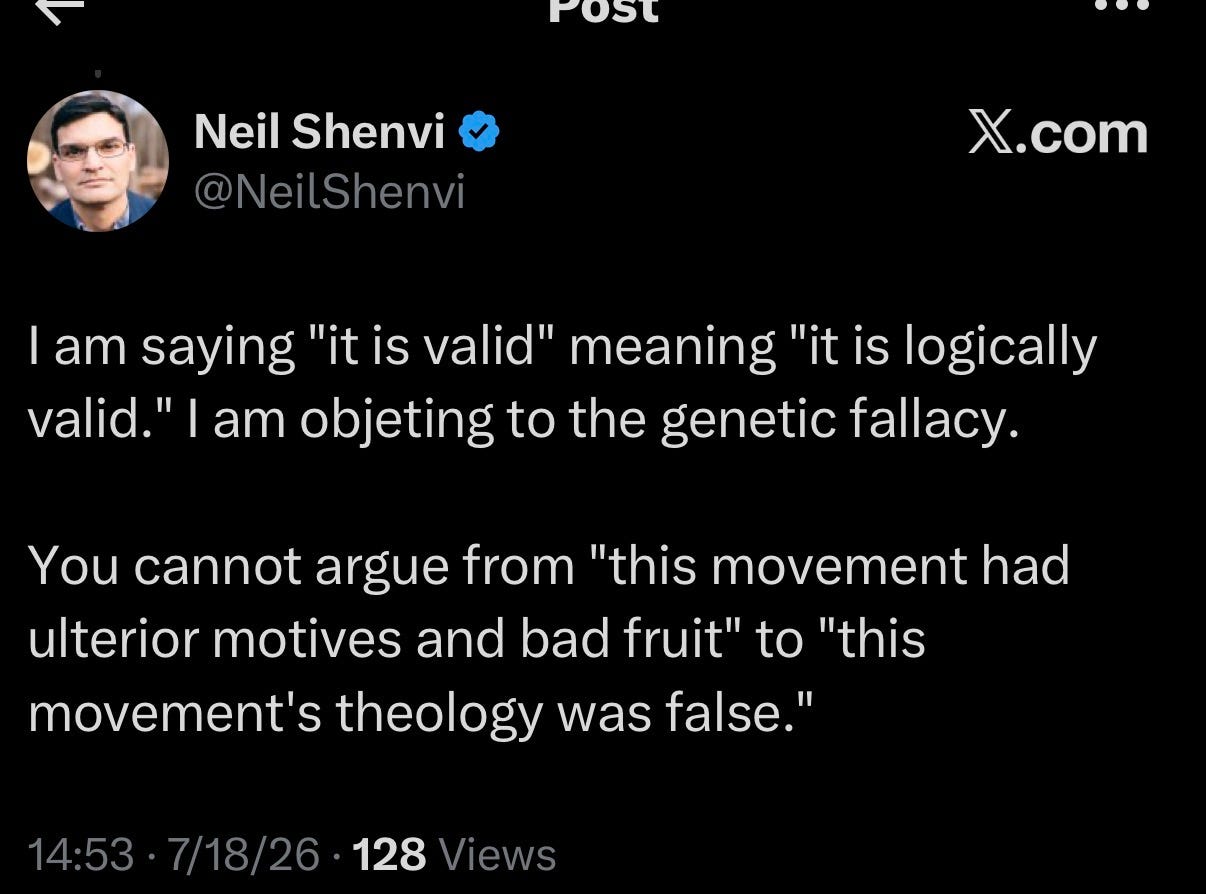
This take isn’t just unbiblical, it’s extremely dangerous.
Shenvi’s assertion that “you cannot argue from ulterior motives and bad fruit” blatantly ignores THE measure Jesus and the Apostles give us to evaluate whether something is good or not. Jesus doesn’t say, “every theological claim is known by its logical consistency” he says, “every tree is known by its fruit”. One of the major faults the church has taken in it’s historical fight against the Enlightenment is relying on the exact same determiners of “truth” as if they are incorruptible. Seeing logical consistency, rational coherence, and the supposed “law of nature” as ultimate arbiters of “truth” actually ignores the Biblical reality that the people employing those things are themselves fallen and sinful. Just because something “makes sense” or has some form of logic to it doesn’t mean it is automatically “Godly”. Jesus himself pointed this out in verses authoritarians love to ignore, “You know that the rulers of the Gentiles lord it over them, and their great ones exercise authority over them. It shall not be so among you. But whoever would be great among you must be your servant, and whoever would be first among you must be your slave, even as the Son of Man came not to be served but to serve, and to give his life as a ransom for many.(Matt. 20:25-28).” The “way of the world” makes sense. It is even logical to think that some should “lord it over” others because of their intelligence, gifting, abilities, etc. But Jesus emphatically states that his kingdom isn’t like that because HE isn’t like that. This is one of the problems patriarchists and authoritarians have is they want to skip to “King Jesus” ruling and reigning while ignoring his life and how he modeled what his kingdom is to be like.
James states that if our theology is “accurate” without love we are no better than demons. Paul says that all the gifting, knowledge, and miracles are utterly useless unless we become more patient, kind, not given to anger, not boastful or proud, etc. What we are called to evaluate is the fruit of whatever thing we are evaluating because that is the clearest indication, told to us in scripture, of whether that thing is truly genuine or not.
And to say that there are merely “bad actors” or “bad fruit” that has come about from the Evangelical obsession with hierarchy and gender is to simply gloss over the incredible damage that has occurred. You have John MacArthur supporting the abuser and slandering and excommunicating the victim multiple times. MacArthur’s seminary teaching thousands of pastors that the police and protective services in abuse situations “aren’t concerned with God’s priorities”. You had generations of pastors who took Wayne Grudem’s theology that abuse wasn’t grounds for divorce and for DECADES told women to remain in abusive marriages with their children. You have John Piper and R.C. Sproul promoting and platforming Doug Wilson a known heretic, misogynist and racist. You have Bill Gothard being feted by HSLDA and even praised while children under his care were taken advantage of for free labor, emotionally and spiritually abused, and in the case of Gothard himself sexually groomed. There’s Paige Patterson who probably embezzled funds at South Western Baptist Seminary while seeking to cover up rape allegations at that school. Paul Pressler literally sex trafficked young men while orchestrating the “Conservative Resurgence”. The stories of shame and harm coming from purity culture and authoritarian parenting are overwhelming. The patriarchal culture DuMez describes in Jesus and John Wayne to this day tells women marital rape isn’t a thing, leaves women unable to extricate themselves from toxic marriages on purpose, and produces emotionally immature and stunted men. This issue isn’t merely about differences in theological opinion, it’s about fathers who have been enabled to assault their children, marriages that are destined to failure, and churches that fall apart because of it. There are lives that have been irrevocably shattered precisely because of this ideology. Even this past week a church lost their pastor, was thrown into a multi-million-dollar lawsuit, and the church leadership is being investigated for criminal conspiracy for allowing a convicted pedophile to interact with children.
All of that is BEFORE you get to the utter erosion of America by Donald Trump. All of the above issues existed BEFORE there were Christian Nationalists literally platforming and espousing Nazi ideologies. And yes, the patriarchal obsession with gender hierarchies very naturally transitioned to racial ones (because they were born out of them). It is the comfort that Evangelicals have with authoritarianism that has created MAGA churches and resulted in the largest abandonment of religion all together for multiple generations.
Again, everything I just stated is FACTUAL. I defy anyone to find one point that is untrue. Shenvi’s question wondering if the source is bad should that be a reason to “deconstruct” the whole is a valid question even if he meant it rhetorically. At this point if you aren’t willing to entertain those questions I would suggest James would say you aren’t even looking into the mirror much less looking and forgetting. The call to examine fruit means we ultimately love people who are hurt rather than our own self-righteousness in an “inerrant” theology. The thing is if you cannot face facts the coward’s way is to claim those facts are invalid because whoever gave them isn’t in your “tribe”. It may still make you feel better but it means you are Ok with hurting people.
(Thanks for reading! I’m always grateful for those who lend me their time. If you want to get my latest please subscribe and consider supporting me in making this content. If you’d like to gift a one-time gift of coffee or dinner, that would also be appreciated https://venmo.com/u/Jason-Mallow-1)
I'm listening to Jesus and John Wayne right now, and DuMez is so thorough in her writing. I've never heard of Shenvi before this (I'm not sad about that), but I immediately recognized how he completely missed what she was saying in the quote you used.
Since I have no knowledge of this man, I don't know whether this misunderstanding was unintentional or disingenuous. I have my suspicions which it is.
As a sidenote, I struggled before I settled on phrasing the misunderstanding as "unintentional or disingenuous." I traditionally question whether missteps are caused by incompetence or maliciousness, but I don't know this guy. That felt too mean. 😂
Thank you Jay. Shenvi’s critique is especially bothersome to me. He has no degrees in history or theology. Yet, he constantly belittles women.
He’s questioned my analyses of statistical and mathematical issues. Again, while I’m sure he’s had some upper level math with his PhD in theoretical chemistry, he still found it necessary to try to dismiss what I was saying about statistical matters because I was a woman with a Master’s in mathematics.
In his mind, I guess, I didn’t have the right equipment.