Reading is fundamental… except for fundamentalists


A mutual online friend Lauren DeMoss Benson got into an argument on Instagram this past week and the responses to her very basic and correct questions about hermeneutics were so bad I felt like I had to comment on it. What makes this significant is there are pastors, politicians, and educators that I would argue literally don’t know how to read. The danger of that illiteracy cannot be understated because these men (and sometimes women) are taking their interpretations as not only as “objective fact” but also imbuing them with divine authority.
Starting at the Beginning
It’s very important to understand at the outset that language, and particularly written language, is always metaphorical. There is nothing concrete and inherent that links the symbols C…A…T with a member of the Felis genus. Not only this, but all language is constituted in community. In a real way the only reason English speakers link the symbols C…A…T to a feline is because we’ve all agreed that those symbols represent that idea. This is one of the main reasons languages are fluid over time. As cultures and the collective that uses the language changes meanings, spelling, and usage necessarily must change as well. So the presumption that language is in any way a “literal” concrete thing is a misunderstanding of what language is.
Translation and Interpretation
This brings me to the offending post that I want to highlight. Here it is,
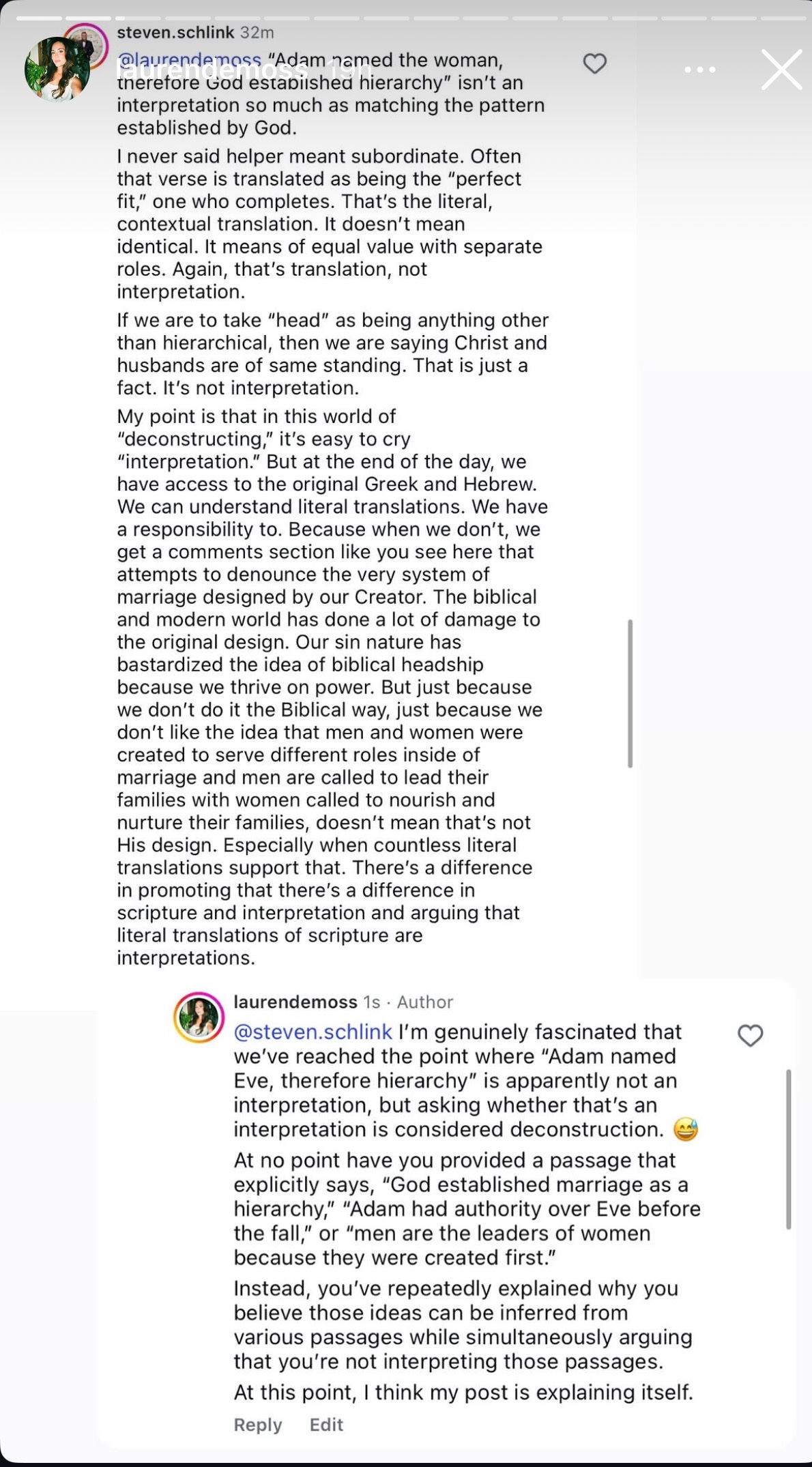
So there’s multiple problems with Steven Schlink’s understanding of translation and interpretation. The first being that translation definitionally deals exclusively with the written text and interpretation normally refers to live spoken word. However, Schlink’s idea of “interpretation” isn’t necessarily wrong colloquially. There is a difference between the decision that these groups of symbols translate to another group of symbols and the meaning both groups of symbols are “interpreted” in each linguistic context (for the record this is included in translation but for our purposes we’re taking them to be somehow separate). A good example of this is the word “orange”, again there is nothing inherent in O…R…A…N…G…E that denotes either the color or the fruit. Obviously in English we’ve decided over the centuries to use the color of the fruit as the name of the color. But in other languages that isn’t the case. Take Russian for example, if referring to the fruit in Russian it is Апельсин (pronounced: ah-peel-SEEN) (yes it is interesting that something we in English consider colloquially to be opposite “apples and oranges” in Russian is in the name of the fruit). If one is referring to the color in Russian it would be Оранжевый (pronounced: ah-RAHN-zheh-vy). Which means when translating it isn’t enough to simply replace Апельсин or Оранжевый with “orange”, one has to know the context and even translate an entire sentence, if not paragraph to know which word is indicated even though it seems easy because both words simply translate to “orange”. It would be in fact harder to translate English into Russian because the English word has multiple meanings that isn’t immediately conveyed in just O…R…A…N...G…E you have multiple possible meanings that can only be discerned by context.
This is even more difficult with other languages, but especially with dead languages. With languages like ancient Greek and Hebrew we are relying on the translation of many different sources speaking into numerous contexts over the span on centuries. Often, especially in Greek, like “orange” there can be multiple contextual meanings for a single word. One example that is much in contention is the word κεφαλὴ in Ephesians 5. Κεφαλὴ most woodenly means “head” translated to English and it is most translated in Greek to mean someone’s literal physical head on top of their body. But we know in context that even if Paul means that Christ is functioning as a literal “head” there is more to the metaphor that he means and here is the contention- does Paul mean mainly a kind of authority/submission relationship like a king to a subject or master to slave or does he mean something different? The first problem is that κεφαλὴ is almost never translated in Greek elseware to have that connotation. There are very few examples where it seems to indicate “authority” but the question is whether Paul in writing to an audience would choose an extremely obscure metaphor over a more ready one. Secondly, even in the passage, even towards slaves, the relationship isn’t what American English speakers presume with the word “submit”. When we often think about “submission” it is forcing compliance against another’s will, or the subjugation of one’s will completely to the will of another. This is in no small part because of our cultural history of chattel slavery. This is so pervasive that modern theologians have stated the master/slave dynamic to be the ideal for the Christian. Consider this from the late John MacArthur,
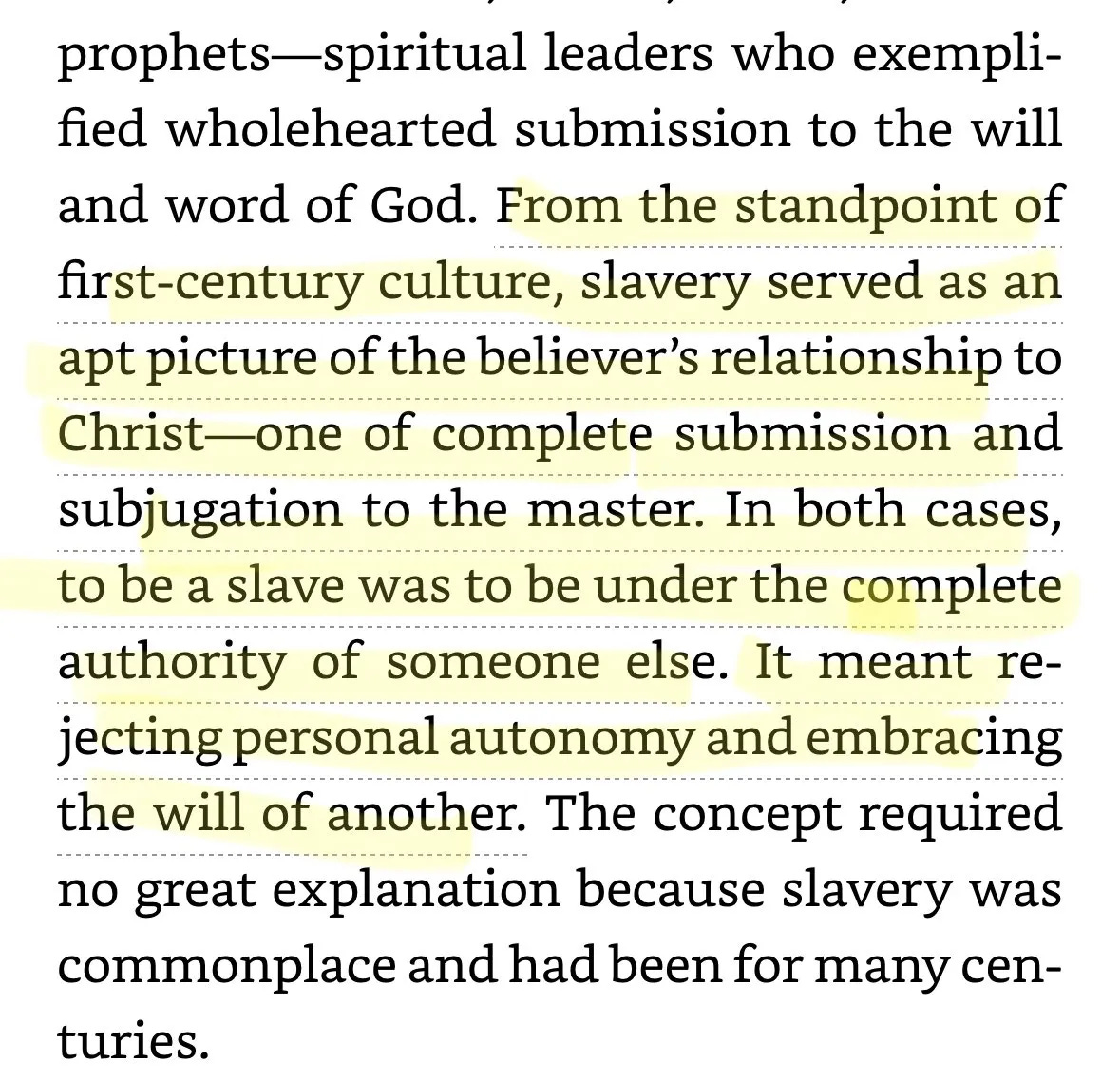
Yet in the passage itself it is an insane disconnect to say women need to submit to men as their “lord and master” while immediately thereafter telling the “master” to emulate Jesus, not by ruling from on high, but by taking the form of a servant and treating the wife as if she were his own body (Eph. 5:28-29). Even later, when it actually comes to masters and slaves, Paul tells masters they are to behave towards their servants in exactly the same way as he has prescribed to the servants (Eph. 6:9). What’s more Paul adds the threat to the master’s that they are under particular scrutiny and judgement from God in the same verse.
Reading as Naive Interpretation
This brings us back to Steven Schlink’s understanding of what he’s “reading”. First, he assumes that the word translated “helper” both indicates a hierarchy which definitionally indicates a subordinate doesn’t actually do so it means “perfect fit”. He actually admits that this is a translation that is “often” rendered which immediately contradicts his next statement that it is the “literal contextual translation”. This runs afoul of the fact that the Hebrew word is most often used in the Old Testament in relation to God and Israel. So the word itself cannot intrinsically mean the presence of a superior/subordinate hierarchy as God as Israel’s “helper” is infinitely superior! What’s more, the emphasis on the whole of Genesis 2 isn’t on the man’s superiority and authority over the woman (as much as those who want to make much of Adam “naming” Eve insist), the emphasis even in Adam’s naming is on Eve’s equivalence to him. So even if you were to claim Adam has a special “authority” in naming Eve he names her his equal.
But Schlink’s hermeneutics gets worse. Schlink states, “If we are to take “head” as being anything other than hierarchical, then we are saying Christ and husbands are of the same standing. That’s just a fact. It’s not an interpretation.” First off, this statement makes no sense but let me try to address it. What is mind boggling screwy is that Schlink is advocating for an interpretation that is the exact opposite of what he claims he is advocating for while claiming that what he is advocating for is somehow different. What I’m going to assume Schlink meant is that is “head” isn’t hierarchical wives and husbands are of the same standing. He’s assuming that some sort of “headship” cannot mean anything but some kind of authority/subordinate relationship. What gets mixed up in his Freudian slip is that his hierarchy precisely in its operation makes the husband have the same standing as Jesus. In a hierarchical model the husband necessarily is a mediator between his wife and God. Demanding total submission to someone else as if they were Jesus means you are putting husbands at the same standing as Jesus. But notice what Schlink is doing, he’s taking an interpretation he already presumes, bringing that to the text, then claiming his interpretation must be the only interpretation and therefore is the authoritative one.
Yes, this has Broad Implications
There is a reason most MAGA conservatives are bad at media literacy. There’s a reason they look at Homelander on The Boys and think he’s a hero. There is a reason they claim to like works like Dune and Lord of the Rings then get mad when Paul ends up being the bad guy or the ring gets destroyed. They come to whatever media they are consuming with presumptions and reading those preconceptions into the media then if anything strays from those presumptions it’s “woke”.
This is particularly pertinent as this week the Southern Baptist Convention has adopted a constitutional amendment that prohibits a woman from any kind of “pastoral” activity. They have decided that the ONLY interpretation that could POSSIBLY be correct is their own and their interpretation intentionally privileges men over women simply because of their genitals.
But this isn’t just about religious matters, this is about people who read the law however they want to. This is about a Supreme Court that decides what the “original authors” meant even when what they say is indicated (like presidential immunity) is not ever actually expressed in the text. It’s how Russ Vought can claim the president can arbitrarily choose what to fund and not fund despite what laws are passed. This kind of “reading” not only allows the “reader” to morph the text into whatever they want, they can also claim special authority because they believe how THEY read anything is the ONLY way it COULD be read despite ample evidence to the contrary.
This isn’t just a differing of beliefs, it’s a fundamental misunderstanding of language and how it works. What I’ve outlined here is a way of seeing the world that makes nuance all but impossible. What’s worse is these same people are unable to see their bias until their belief structure is shattered.
I firmly believe that shattering moment is coming eventually for everyone but in the meantime wisdom might be deciding to not attempt to engage with illiterate people who are convinced their meager knowledge offers them certainty.
Welcome to the Resistance
(Thanks for reading! I’m always grateful for those who lend me their time. If you want to get my latest please subscribe and consider supporting me in making this content. If you’d like to gift a one-time gift of coffee or dinner, that would also be appreciated https://venmo.com/u/Jason-Mallow-1)
I agree with your overall point, but I do think he meant what he said about ‘head’ being hierarchical. I immediately took it as referring to Christ as the head of man (1 Cor 11:3), or of the church (Eph 5:23). It appears that he believes that undermining the authority of husbands over wives in these passages undermines Christ’s authority over men/the church. Now, why he is so invested in authority and hierarchy rather than unity and service, well, I think preservation of one’s own power over women and other ‘lessers’ seems to fit the bill.
I recently had an entertainingly stupid exchange with a man here on Substack who would make exactly the sort of claims that you call out in this article...that there was no such thing as "faithful disagreement", that the Bible meant what it said (which was conveniently what he said it meant) and he didn't have to explain himself because "real Christians" would automatically agree. He even has posts in his profile saying that the fact the SBC even debated allowing women pastors shows how "weak", "liberal" and "compromised" they are.
It's refreshing to read an article calling out the fact that language in any form is a conversation.