Hannah's Song
What 1 Samuel has to do with Advent

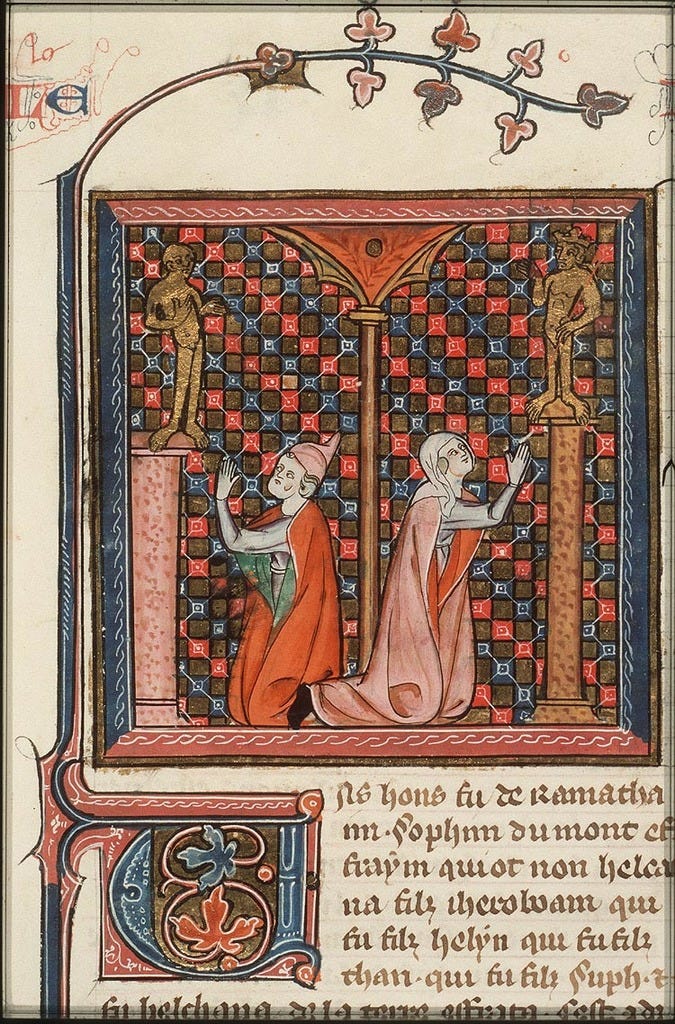
(Hello everyone! I repost three posts every year in celebration of Christmas. This was originally posted December 2023)
With us getting to Advent, I thought I would connect a favorite passage of mine with not only the narrative of Christ’s coming but the Great Story being told overall. Many would not think that the beginning of 1 Samuel is filled with themes we should see all over God’s redemption story but that’s because Hanna’s story is mostly read as a “nice” story of individual devotion (Hannah’s), not an allegorical representation of Israel.
The Backdrop: The Darkness of Judges
1 Samuel begins during some of the darkest days in the history of Israel. Start at the end of Judges and go just a few chapters back and you’ll see some of the worst sin recorded in all of scripture. And it’s not just individual sins, there are corporate decisions the assembly makes that are utterly godless. Judges ends with the sad statement, “In those days there was no king in Israel. Everyone did what was right in his own eyes.” This statement is meant to highlight the seeming futility and fruitlessness of Israel over the time of the Judges. They are no better (and arguably worse) than they were more than a generation ago. What’s more, this statement speaks to the culture of Israel (readily seen in Judges) that everyone looked to their own good. Justice was what you could get for yourself.
A Corrupt Priesthood
Even worse, we find out in the beginning of 1 Samuel that the rot had infected those closest to God who were supposed to represent the people to God and God to the people. Eli and his sons have gotten fat (literally) off the faithful bringing sacrifices to God. What’s more, Eli’s sons abuse the women who desired to serve God (1 Sam. 2:12-22). God was so disrespected, so tokenized, that they used the Ark as a prop for their battles (1 Sam. 4).
A Representational Family?
It is then somewhat remarkable that 1 Samuel begins with what at first appears to be a small story. A faithful man with two wives who worships God. However, one wife who is favored is barren and the other wife has many children. Hebrew readers would immediately pick up on parallels between Hannah and her “tormentor” and Rachael and Leah (Gen 30). It would be picked up by those this was originally written to that Hannah would be a kind of representational Israel. She’s the favored one who is apparently fruitless who is experiencing the derision of her enemies (Sarah and Hagar, Rachel and Leah).
Hannah’s request is far more significant than it would first appear as well. To a Western modern reader, it would appear Hannah is “bartering” with God. Saying “If you do this for me, I’ll do this.” But in the Jewish tradition and historical context that isn’t what she is doing. To understand this, we must know what was assumed about barrenness in the ancient world. First it would be assumed that she was unloved by her husband. The immediate assumption would be that her husband simply wasn’t sleeping with her. This is why Elkanah publicly gives Hannah a double portion, He’s signifying she is his favorite despite her barrenness (possibly an analogy of God’s continued favor to Israel?). The other assumption would be that God had “cursed” Hannah. That for some reason God had prevented her from conceiving (we are actually told in the narrative this is the case). This is probably the “torment” Peninnah Hannah’s sister wife gives to her. The “accuser” is claiming her lack of “fruit” is her fault.
This is why Hannah’s intentional reference to her “first born” matters. What Hannah is desperately crying out to God for (and isn’t it interesting the text doesn’t condemn her emotion but condemns a man for rebuking her) is that He remove her reproach. Hannah is asking God to act in her life as he acted on Israel’s behalf in removing her shame and silencing the mouth of her accuser. Her first-born son should already be dedicated to God, what she wants more than a son is for God to show her and her community that he loves her.
The Significance of זָכַר
The connection to the Exodus and so much more comes in verse 19 with one phrase “the LORD remembered her”. The word “remember” (זָכַר) is used all over Genesis and Exodus to indicate God acting redemptively. It’s used with Noah in the Ark (Gen. 8:1), God opening Rachel’s womb (Gen. 30:22), but most importantly God “remembering” his people in Egypt (Ex. 2:24, 6:5). The implication is that yes, God is doing for Hannah what she asked and “redeeming” her. But later Hannah recognizes that her birth has a greater significance. That what God is doing in her story is an indication of what God is doing with his people.
Hannah’s Song
This is where Hannah recognizes something is happening in this provision for her that is bigger than just her and her family. In the inclusion of her prayer, her song, she becomes the herald of the coming time. The days of lawlessness and darkness are coming to an end. The arrogant are cast down, the corrupt and boastful are being weighed by God, “Talk no more so very proudly, let not arrogance come from your mouth; for the LORD is a God of knowledge, and by him actions are weighed. The bows of the mighty are broken, but the feeble bind on strength. (1 Sam. 2:3-4) Ultimately the time of the king is coming, “He will guard the feet of his faithful ones, but the wicked shall be cut off in darkness, for not by might shall a man prevail. The adversaries of the LORD shall be broken to pieces; against them he will thunder in heaven. The LORD will judge the ends of the earth; he will give strength to his king and exalt the horn of his anointed.” (1Sam. 2:9-10) The inclusion of Hannah’s song is an indication that God is doing something in Israel that is like what He is doing in this seemingly insignificant family.
What we see in the coming chapters is God moving among his people. First, He prophesies against Eli and his sons, exposing, naming, and judging them cleansing the priesthood. Then there is the establishment of Samuel as a prophet and priest who re-establishes the priesthood after the corruption is exposed and dealt with (in fact this is probably Samuel’s main calling). Finally, Samuel then ushers in the kingship. Even with all the wickedness that happens under Israel’s kings, they don’t go back to the lawless days of the Judges.
1 Samuel and Advent
Luke especially has parallel imagery pulled from the Old Testament. Zechariah’s Announcement is in many ways a condemnation of the priesthood. Of all people Zechariah should have put “angel announcing an elderly barren woman conceiving” together with “God moving redemptively”, but he doesn’t. In some ways ironically, in other ways perhaps necessarily, it is a young woman Mary who pieces together that something greater is happening. Perhaps it took a woman enduring scorn (there’s a reason Mary spends most of her pregnancy with Elizabeth) to recognize a barren woman bearing a son of a priest recognizing the son of the king looks a lot like 1 Samuel. Mary’s song, her Magnificat, parallels Hannah’s almost exactly.
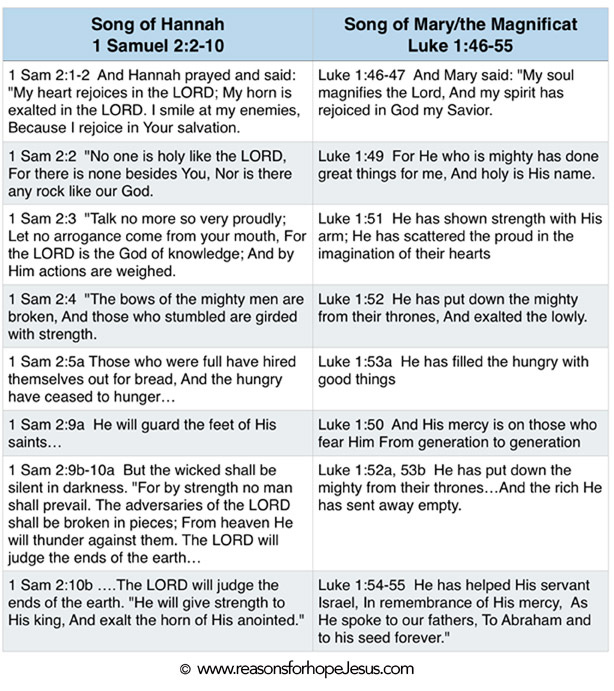
But there are two verses that really tie in God’s narrative that Mary recognizes, “He has helped his servant Israel, remembering his mercy, to Abraham and his descendants forever.” (Lk. 1:54-55 translation mine) Mary recognized that God was remembering his people, like with Abraham, the Exodus, and obviously Hannah.
Every Valley
One of my favorite solo’s is Handel’s version of Isaiah 40, especially if sung by a baritone. The words we often only attribute to the Advent and the coming of John the Baptist. However, in the first few verses you have themes that, more poetically, are mirrored in both Hannah and Mary’s songs. Particularly verse 4, “Every valley shall be raised up, every mountain and hill made low; the rough ground shall become level, the rugged places a plain.” The imagery the prophet uses speaks of that which is low being exalted, and that which is “exalted” made low, that which is rough or “crooked” being made level (right, just, true, etc.). But what we might miss is what the “rugged places plain” means. Israel is notoriously rocky ground. In order for any farming to be done the ground needs to be prepared and this is more than just tilling. The rocks need to be dug up; bedrock possibly broken through. The soil has to be broken, sifted, then plowed. A prophet in 1 Samuel and in Luke needs to come before the king to break up the stony ground of the people’s hearts to prepare the way. The barren places of Israel (Judges and the inter-Tesimental period) being made able to be fruitful.
What you have in Hannah and Mary’s songs and their lives is a microcosm of the barren places made fruitful, of the lowly being exalted, of the hopeless given hope, of the “proud” in their accusations being cast down. What they represent in individual expression both Hannah and Mary recognized was what was happening to Israel as a whole. These women and the writers of scripture realized this, and that is why their songs are recorded for us. And I believe it is important for us to note that God choose women to be the heralds of His salvation. They are singing His song that reverberates throughout the scriptures. But more on that next week…
(Thanks for reading! I’m always grateful for those who lend me their time. If you want to get my latest please subscribe and consider supporting me in making this content. If you’d like to gift a one-time gift of coffee, dinner, or a Christmas gift, that would also be appreciated https://venmo.com/u/Jason-Mallow-1)
Despite my namesake this is the first I’m hearing of some of these connections - especially God “remembering” as the operative phrase. Thank you for this!